Symmetry Breaks in Simulated Decks: Detecting Non-Random Shuffles Across Global Online Poker Networks
Online poker platforms rely on simulated decks generated through random number generators, yet researchers have documented cases where statistical patterns reveal deviations from true randomness across multiple networks operating in different regions. These deviations, often described as symmetry breaks, occur when the distribution of card sequences fails to match the expected uniform probabilities that physical shuffles produce under repeated trials. Data from independent testing labs shows that such breaks can appear in the ordering of suits, ranks, or specific combinations like paired cards and suited connectors, prompting ongoing audits by regulatory bodies outside the United Kingdom.
Core Mechanisms Behind Simulated Deck Generation
Software providers implement pseudorandom number generators seeded with system entropy or external sources to produce card sequences that mimic physical decks, and these sequences undergo multiple rounds of transformation before reaching player interfaces. Observers note that true randomness requires each possible permutation to hold equal probability, a condition that breaks when algorithmic biases or insufficient entropy sources introduce repeatable structures in the output stream. Studies conducted by academic teams at institutions in North America have applied tests such as the NIST statistical suite to large samples of poker hands, revealing clusters where certain card transitions appear more frequently than chance alone predicts. Those who've examined logs from platforms licensed in the European Union report similar patterns emerging during peak traffic periods, when server loads may influence the speed or quality of entropy collection.
Statistical Methods for Identifying Symmetry Breaks
Analysts deploy chi-square goodness-of-fit tests alongside runs tests and serial correlation measures to compare observed card frequencies against theoretical baselines derived from 52-card combinatorics. When symmetry breaks surface, the p-values drop below established thresholds, indicating that the shuffle process has departed from independence assumptions. Research teams in Australia have published findings that track these anomalies across thousands of simulated deals collected from public game histories, while Canadian regulators have required operators to submit raw RNG output for periodic verification against similar benchmarks. One study revealed that breaks often concentrate in the first few cards dealt after a new deck initialization, a detail that network monitors now flag automatically through real-time dashboards.
Global Network Variations and Detection Challenges
Platforms serving players in Asia, Latin America, and North America employ different RNG implementations, which creates a patchwork of testing standards that complicate cross-network comparisons. Figures from industry reports compiled in July 2026 indicate that operators in regulated markets submit monthly samples exceeding one million hands for external review, yet discrepancies persist when the same software stack runs under varying hardware configurations. Experts have observed that virtual private servers and cloud instances can alter the timing of entropy harvesting, leading to subtle periodicity that statistical filters catch only after aggregation across multiple sites. Those monitoring these systems note that detection grows more reliable when analysts combine positional data, such as flop textures or river card distributions, with raw sequence analysis rather than relying on any single metric.
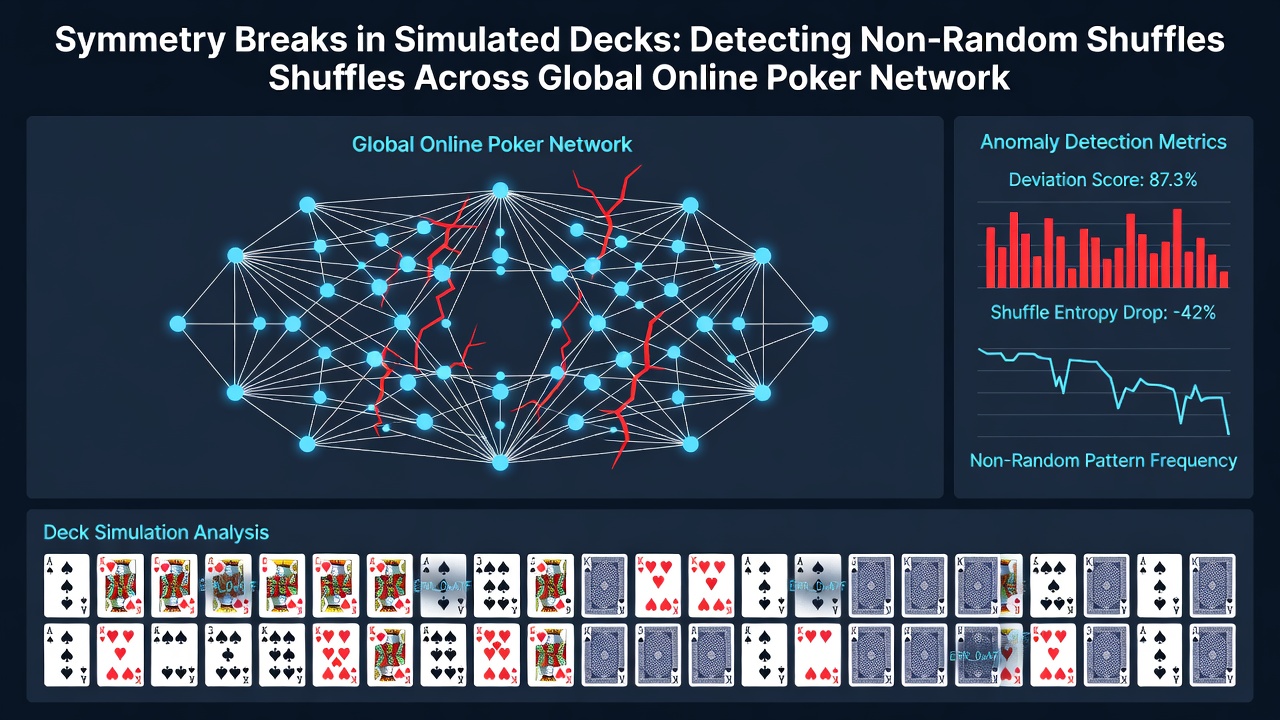
Regulatory frameworks in Nevada and several Australian states mandate third-party certification that includes entropy source validation and long-term distribution testing, and operators must demonstrate that any detected breaks trigger immediate reseeding protocols. Data shared through gaming association channels shows that corrective actions, such as switching to hardware random number generators, have reduced measurable deviations in subsequent audits. Yet the reality remains that legacy software on smaller networks continues to exhibit patterns that skilled observers can identify through careful sampling and comparison against established mathematical models.
Case Examples from Network Audits
Take one documented audit conducted on a multi-jurisdictional platform where researchers discovered elevated frequencies of Ace-King suited combinations in early position deals over a six-month window. The team cross-referenced timestamped logs with server performance metrics and traced the anomaly to a software update that altered the shuffling algorithm's internal buffer size. Another instance involved a network operating under Caribbean licensing where serial correlation tests flagged repeating blocks of low cards during late-night sessions, prompting a full RNG replacement after independent verification. These examples illustrate how symmetry breaks manifest differently depending on the underlying code architecture and operational environment.
Future Monitoring Approaches
Advances in machine learning now allow continuous monitoring systems to flag potential breaks before they reach statistical significance in traditional tests, and several licensing authorities have begun requiring operators to integrate such tools into their compliance pipelines. Research indicates that combining entropy health checks with outcome distribution tracking provides earlier warnings across diverse geographic deployments. Observers continue to track developments as new platforms launch with updated generators, noting that transparent reporting of test results remains essential for maintaining player confidence in the integrity of online poker ecosystems.
Conclusion
Global online poker networks face ongoing scrutiny regarding the randomness of their simulated decks, with symmetry breaks serving as key indicators that statistical protocols can detect and address. Regulatory bodies in multiple regions enforce testing regimes that rely on established mathematical methods, while emerging techniques offer improved sensitivity. Continued vigilance through independent audits and data sharing supports the maintenance of fair play standards across these digital environments.