Stacked Wilds and Multiplier Cascades: Building Layered Payouts in Modern Slot Bonus Rounds

Modern slot games incorporate multiplier cascades through sequences of stacked wild symbols that trigger successive payouts and increase values across extended bonus rounds, according to industry mechanics documented by gaming software providers. These systems operate by aligning wilds in vertical stacks on reels, which then substitute for other symbols to complete winning combinations while applying progressive multipliers that build with each cascade step. Data from gaming association reports shows that such features appear in titles released after 2020, where bonus rounds extend beyond standard spins through repeated activations.
Mechanics of Stacked Wild Sequences
Stacked wilds occupy entire reels or multiple positions in a column, and when they land during bonus play they initiate cascades by removing matched symbols and dropping new ones from above. This process repeats as long as new wins form, with each subsequent cascade adding to a running multiplier that starts at 1x and rises by increments of 1x or more per level reached. Observers note that developers program these sequences to reset or carry over multipliers depending on the specific game rules, which creates layered payout structures where initial small wins feed into larger ones over the course of a single bonus session.
Research from university studies on random number generators in gaming confirms that the probability of stacked wild appearances increases during bonus modes because those rounds often feature enhanced reel strips or additional wild reels. One analysis of game mathematics revealed that this design allows for chain reactions spanning five or more cascades in a row, each layer multiplying the prior payout total before the round concludes or transitions to a new phase.
Layered Payout Structures in Extended Bonus Rounds
Bonus rounds in these slots typically begin with a set number of free spins or a pick-and-reveal mechanic that unlocks additional rounds, during which stacked wild sequences activate the cascade system. Each layer of the payout structure compounds because teh multiplier persists across cascades while new wild stacks land and expand the grid or trigger extra rows. Figures from gaming industry reports indicate that extended bonus rounds can last 20 to 50 spins on average in games that use this model, with payout accumulation occurring through successive symbol drops rather than isolated spin results.
Take the example of one popular title where three stacked wilds on adjacent reels start a cascade that clears the screen and applies a 2x multiplier, after which fresh symbols fall and produce another win at 3x before the sequence ends. Experts have observed that this layering effect relies on the game's engine tracking every cascade step independently yet cumulatively, so the final payout reflects the product of all multipliers applied during that chain. And because the bonus round extends automatically when certain thresholds like four cascades are met, players encounter prolonged sequences that build the layered totals without additional bets.
Technical Implementation Across Game Providers
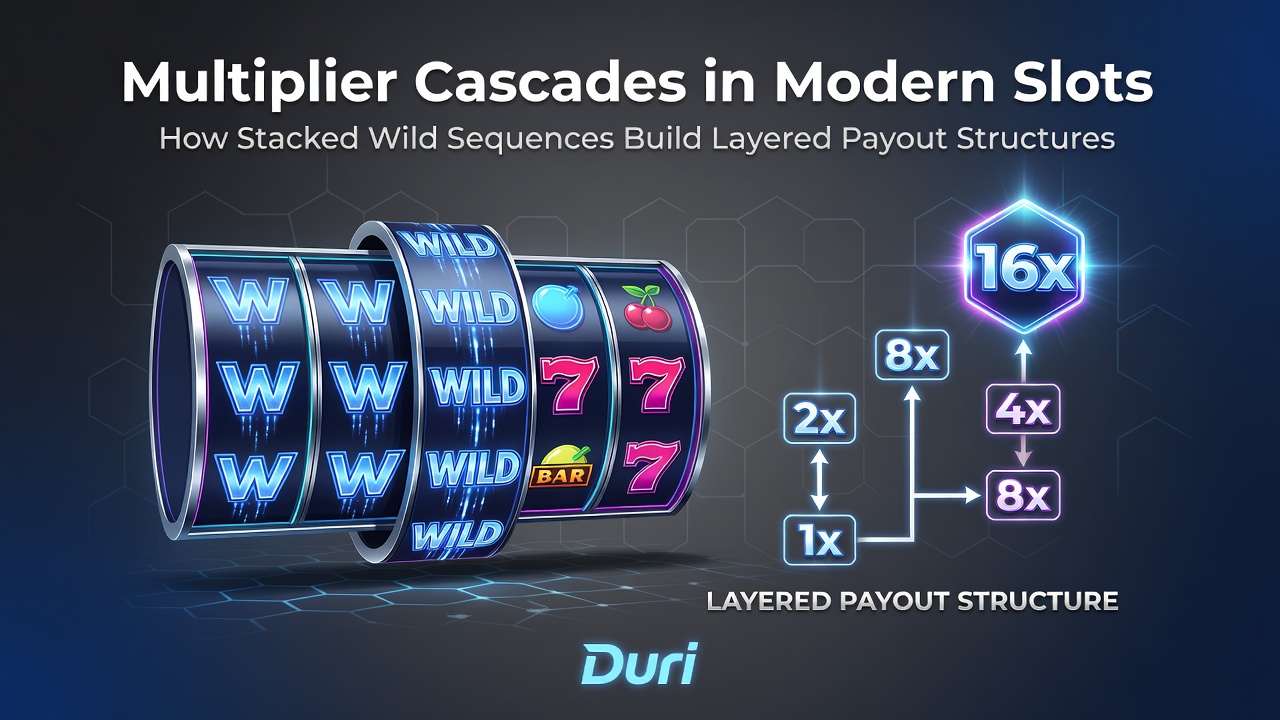
Software developers integrate these cascades using proprietary algorithms that balance hit frequency with multiplier growth rates, as outlined in technical white papers from major studios. The stacked wild placement follows weighted reel distributions that favor bonus play, while the cascade engine handles symbol removal and replacement in real time to maintain game pace. Those who've studied slot mathematics know that the layered payout structure emerges from the interaction between wild persistence across cascades and the multiplier increment rules, which differ by title but generally cap at values between 10x and 100x to control volatility.
According to data shared by the American Gaming Association, slots featuring cascade mechanics account for a growing share of new releases because they sustain engagement through the visual and numerical progression of multipliers. What's interesting is how the system separates base game play from bonus rounds, with the latter designed for longer chains that reveal the full layered potential without altering the underlying random outcomes.
Examples from Documented Game Designs
One study of slot volatility patterns found that games using stacked wild cascades in bonuses produce payout distributions where 60 to 70 percent of total returns occur during extended sequences rather than single spins. Developers achieve this by programming wild stacks to appear more densely once the bonus activates, which triggers the cascade loop and allows multipliers to compound across multiple layers. There's this case where experts analyzed a cluster of titles and noted that the longest recorded bonus rounds exceeded 40 cascades in succession, resulting in multiplier totals that multiplied initial line wins by factors exceeding 50x before the round terminated.
Industry organizations such as the European Gaming and Betting Association have compiled reports showing consistent use of these structures across markets in North America and Asia, where regulatory testing verifies that the cascade logic adheres to approved random number generator standards. The reality is that each game specifies its own rules for when cascades stop and how multipliers reset, yet the core process of stacked wilds building layered payouts remains uniform in its execution during bonus play.
Conclusion
Multiplier cascades driven by stacked wild sequences form the foundation for layered payout structures that unfold across extended bonus rounds in contemporary slot designs. These mechanics rely on precise programming of symbol behavior, multiplier progression, and round extension rules to deliver cumulative results that data from regulatory bodies and research institutions continue to track. As game providers refine these systems, the documented patterns of cascade chains and layered accumulation provide the factual basis for understanding how such features operate within approved gaming frameworks.